
Bluffer’s Guide: Fortress China

Bluffer’s Guide: Fortress China, Air Defenses
Caveat: Amateur web research. This is not intended as authoritative or exhaustive. All illustrations by me unless otherwise stated. Constructive feedback and corrections welcome. I am particularly indebted to Sean O’Connor (SOC) and the Google Earth hawks at his forum, also to the countless Chinese military observers who hang at such places as (thanks Xinhui!) and http://www.sinodefenceforum.com/ (thanks Crobato!).
Contents
1. Intro
2. Main area-defence systems
3. Tactical systems
4. Anti-Stealth and countermeasures
5. Beijing defenses
6. Shanghai defenses
7. Taiwan Straight defenses
8. Hong Kong defenses
9. A few other places
1. Intro
Militarily, China is a country of contrasts, with undoubtedly among the most powerful militaries in the world. A hot topic is whether China could beat USA in a conventional war – You can make your own mind up on that point, but the mere fact informed people discuss that shows that irrespective of what the naysayers would have us believe, China is a force to be reckoned with.
Like many countries China deploys ground-based air-defenses to protect against sudden air attack. The fact that China’s arsenal is far larger than most countries is more a factor of the size of the country and growing world standing, rather than an indicator of a militarized society IMO. Armed with a formidable arsenal of nuclear weapons and rapidly maturing delivery capabilities, China has little to worry about in terms of major invasion.
Nonetheless China is surrounded by potential adversaries, particularly the US pacific forces and Taiwan. With Taiwan, the aggressor is definitely China of course. China also watches the sustained military might of Japan and flowering capabilities of South Korea with a weather eye. Russia flits from being friend to cold neighbor every few years; don’t let the fact that China has been a major arms customer fool you. Elsewhere China continues to have cold relations with its new nuclear rival, and old territorial rival, India. Pakistan is a friend and ally but now has nuclear weapons and thanks to China the capability to deliver them to Chinese cities so in the longer run things may get interesting there. Vietnam also is a potential threat but any conflict with them would be very localized. The last neighbors, the former Soviet states on the Western fringes of China, are somewhat of a mixed bunch but unlikely to be serious adversaries.
In the 1950s a Communist China courted Soviet support, but after Stalin’s death this relationship soon faltered and the Communist countries where thrown into a three-way cold war with each other and the West. Certainly in USSR many saw China as a far more likely adversary than USA in 1960s and some Stalinist hardliners may even have plotted to start a nuclear war between US and China as a means of naturalizing Mao (see “Red Star Rogue”).
What this meant for China’s air defenses wasn’t good. China had only received a handful of early model SA-2 Guidelines which were already nearly obsolete. These were quickly reverse engineered and entered service as the HQ-1 and soon after HQ-2 systems. The HQ-2 remains a major cornerstone of Chinese air defenses. Chinese attempts at indigenous SAMs were somewhat poor even after an injection of Western technologies during the 1970s and 80s when China was an awkward bedfellow of the West against the USSR.
Coinciding with the implosion of the Soviet Union, Russia was plunged into financial turmoil and desperate to sell its military technology, even to its old foe China. Consequently China imported advanced SAM systems. This also helped China’s slow indigenous programs.
In the 200s China deploys are relatively wide range of advanced Russian and indigenous systems, backed up by large quantities of legacy HQ-2 systems.
Summarizing the above, in the 1960s-80s the main strategic adversary was USSR and consequently most air defenses are concentrated in the north of the country, and are often deployed on the north side ofd cities even today. However, in the 1990s and 2000s the focus has returned to the financial hub of Shanghai (and now Hong Kong) and the Taiwan Straight.
2. Main area-defense systems


HQ-9 SAM
A Chinese indigenous system analogous with the Russian S-300 series, the HQ-9 has had a long gestation but is now being deployed in some numbers. Contrary to many published statistics, the missile is somewhat smaller than the S-300’s, and is probably a single-stage weapons. Many design features are borrowed from the S-300 series but also with many features of the US Patriot system, presumably gleaned by espionage in US and China’s Western-aligned neighbors.
Battery configuration is modeled on the S-300. Range is about 90km (I don’t buy the 200km claim) and the system probably has good multi-target and modest ABM capability. It is certainly a formidable system. Illustrations represent the production versions as best I can tell:


The HQ-9 dimensions estimates:


S-300 P series (SA-10 and SA-20)
The first S-300s delivered to China were S-300PMU, the export version of the SA-10B Grumble. These were initially deployed around Beijing although two of the batteries have probably been redeployed elsewhere as better systems replace them around Beijing.


In the late 1990s the S-300PMUs were succeeded by the more capable S-300PMU-1 system. Unlike its predecessor, China opted for the less mobile trailer-mounted missile TEL. Pretty much all export versions of the S-300/400 series can be mounted on either the classic Maz truck TEL, or a towed trailer. Generally China observers reverse the relationship assuming that the trailer mounted examples are the older PMUs rather than the more widespread PMU-1.

The PMU-1 introduced a more capable missile and the impressive ‘Big Bird’ radar. These are usually deployed in separate sites serving multiple S-300 batteries and can be likened to “land-Aegis”.

The antenna rotates but has phased arrays on both sides so it can search two sectors at once.
China has also started to receive the PMU-2 ‘Favorit’ system. Like the PMU-1s this is mounted on a trailer but uses a different tractor, the same as is often associated with the S-400 system. The PMU-2 has genuine 195km range.

HQ-12 (KS-1A)
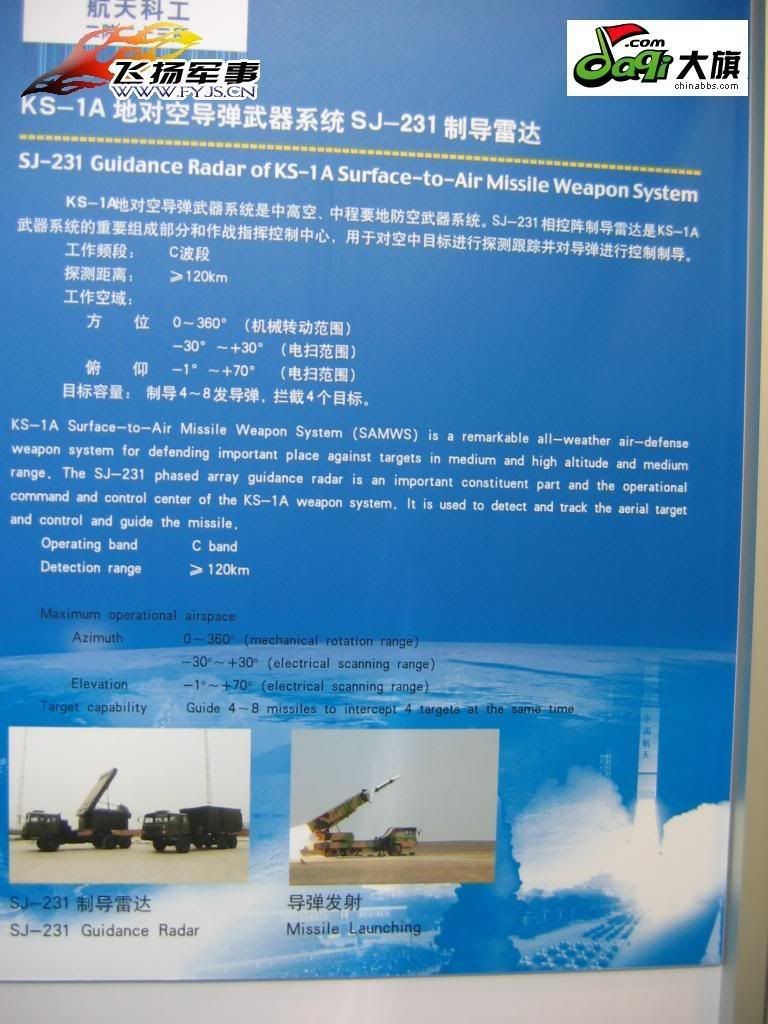
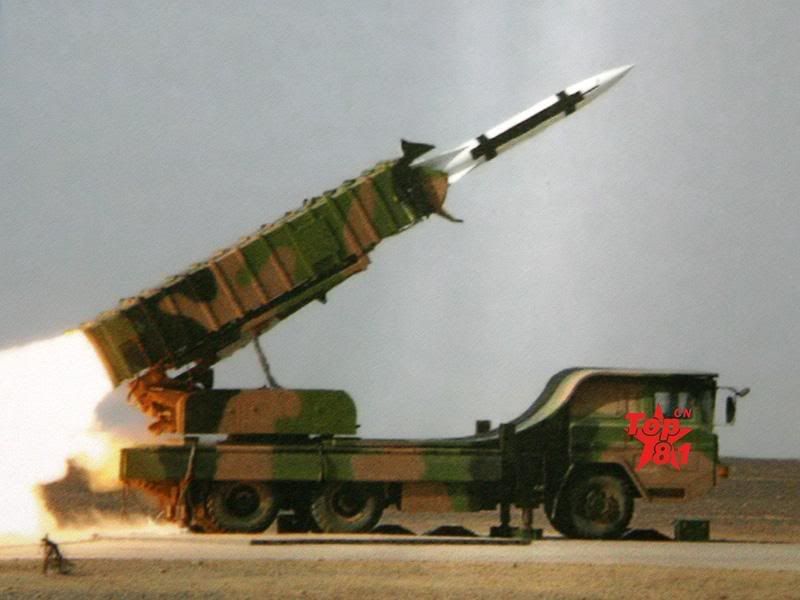
The HQ-12 is an indigenous Chinese system derived from the HQ-2. Despite a passing resemblance to the upper stage of the HQ-2 the missile is in fact completely new and features a single stage solid-fuelled rocket with a range of about 50km (better than the 35km of the HQ-2). Development has been somewhat protracted but the system appears to have entered widespread service slowly replacing HQ-2s. Probably developed as a contingency to the more sophisticated HQ-9, it is plausible that the HQ-12 is now viewed as the cheaper alternative to the S-300 and HQ-9 systems. One aspect where the HQ-12 is quite strong however is in terms of radars, which are cross-pollinated with the HQ-9 program. Despite certain hangovers from the old HQ-2, and being generally less capable than the HQ-9/S-300s, the HQ-12 is a very capable system providing credible modern air defense to less-strategic locations.


HQ-2 SAM
The Chinese version of the Soviet SA-2, the HQ-2 has been deployed in successive versions. The system is undoubtedly the least capable Chinese area-defense SAM but remains prominent. Range is about 35km but altitude is good. Although Chinese systems may be more capable than the SA-2s, they still suffer from multi-target and mobility limitations.


The below photo shows that even in 2007 PLA was still building HQ-2 sites, although it has been suggested that this is an HQ-12 site with HQ-2 deployed as an interim arrangement. Either way it’s likely that he HQ-2s here have been displaced from a higher priority location where they have been replaced by one of the multitude of more advanced systems field by China.

Bluffer’s Guide: Fortress China, Air Defenses
Caveat: Amateur web research. This is not intended as authoritative or exhaustive. All illustrations by me unless otherwise stated. Constructive feedback and corrections welcome. I am particularly indebted to Sean O’Connor (SOC) and the Google Earth hawks at his forum, also to the countless Chinese military observers who hang at such places as (thanks Xinhui!) and http://www.sinodefenceforum.com/ (thanks Crobato!).
Contents
1. Intro
2. Main area-defence systems
3. Tactical systems
4. Anti-Stealth and countermeasures
5. Beijing defenses
6. Shanghai defenses
7. Taiwan Straight defenses
8. Hong Kong defenses
9. A few other places
1. Intro
Militarily, China is a country of contrasts, with undoubtedly among the most powerful militaries in the world. A hot topic is whether China could beat USA in a conventional war – You can make your own mind up on that point, but the mere fact informed people discuss that shows that irrespective of what the naysayers would have us believe, China is a force to be reckoned with.
Like many countries China deploys ground-based air-defenses to protect against sudden air attack. The fact that China’s arsenal is far larger than most countries is more a factor of the size of the country and growing world standing, rather than an indicator of a militarized society IMO. Armed with a formidable arsenal of nuclear weapons and rapidly maturing delivery capabilities, China has little to worry about in terms of major invasion.
Nonetheless China is surrounded by potential adversaries, particularly the US pacific forces and Taiwan. With Taiwan, the aggressor is definitely China of course. China also watches the sustained military might of Japan and flowering capabilities of South Korea with a weather eye. Russia flits from being friend to cold neighbor every few years; don’t let the fact that China has been a major arms customer fool you. Elsewhere China continues to have cold relations with its new nuclear rival, and old territorial rival, India. Pakistan is a friend and ally but now has nuclear weapons and thanks to China the capability to deliver them to Chinese cities so in the longer run things may get interesting there. Vietnam also is a potential threat but any conflict with them would be very localized. The last neighbors, the former Soviet states on the Western fringes of China, are somewhat of a mixed bunch but unlikely to be serious adversaries.
In the 1950s a Communist China courted Soviet support, but after Stalin’s death this relationship soon faltered and the Communist countries where thrown into a three-way cold war with each other and the West. Certainly in USSR many saw China as a far more likely adversary than USA in 1960s and some Stalinist hardliners may even have plotted to start a nuclear war between US and China as a means of naturalizing Mao (see “Red Star Rogue”).
What this meant for China’s air defenses wasn’t good. China had only received a handful of early model SA-2 Guidelines which were already nearly obsolete. These were quickly reverse engineered and entered service as the HQ-1 and soon after HQ-2 systems. The HQ-2 remains a major cornerstone of Chinese air defenses. Chinese attempts at indigenous SAMs were somewhat poor even after an injection of Western technologies during the 1970s and 80s when China was an awkward bedfellow of the West against the USSR.
Coinciding with the implosion of the Soviet Union, Russia was plunged into financial turmoil and desperate to sell its military technology, even to its old foe China. Consequently China imported advanced SAM systems. This also helped China’s slow indigenous programs.
In the 200s China deploys are relatively wide range of advanced Russian and indigenous systems, backed up by large quantities of legacy HQ-2 systems.
Summarizing the above, in the 1960s-80s the main strategic adversary was USSR and consequently most air defenses are concentrated in the north of the country, and are often deployed on the north side ofd cities even today. However, in the 1990s and 2000s the focus has returned to the financial hub of Shanghai (and now Hong Kong) and the Taiwan Straight.
2. Main area-defense systems
HQ-9 SAM
A Chinese indigenous system analogous with the Russian S-300 series, the HQ-9 has had a long gestation but is now being deployed in some numbers. Contrary to many published statistics, the missile is somewhat smaller than the S-300’s, and is probably a single-stage weapons. Many design features are borrowed from the S-300 series but also with many features of the US Patriot system, presumably gleaned by espionage in US and China’s Western-aligned neighbors.
Battery configuration is modeled on the S-300. Range is about 90km (I don’t buy the 200km claim) and the system probably has good multi-target and modest ABM capability. It is certainly a formidable system. Illustrations represent the production versions as best I can tell:
The HQ-9 dimensions estimates:
S-300 P series (SA-10 and SA-20)
The first S-300s delivered to China were S-300PMU, the export version of the SA-10B Grumble. These were initially deployed around Beijing although two of the batteries have probably been redeployed elsewhere as better systems replace them around Beijing.
In the late 1990s the S-300PMUs were succeeded by the more capable S-300PMU-1 system. Unlike its predecessor, China opted for the less mobile trailer-mounted missile TEL. Pretty much all export versions of the S-300/400 series can be mounted on either the classic Maz truck TEL, or a towed trailer. Generally China observers reverse the relationship assuming that the trailer mounted examples are the older PMUs rather than the more widespread PMU-1.
The PMU-1 introduced a more capable missile and the impressive ‘Big Bird’ radar. These are usually deployed in separate sites serving multiple S-300 batteries and can be likened to “land-Aegis”.
The antenna rotates but has phased arrays on both sides so it can search two sectors at once.
China has also started to receive the PMU-2 ‘Favorit’ system. Like the PMU-1s this is mounted on a trailer but uses a different tractor, the same as is often associated with the S-400 system. The PMU-2 has genuine 195km range.
HQ-12 (KS-1A)
The HQ-12 is an indigenous Chinese system derived from the HQ-2. Despite a passing resemblance to the upper stage of the HQ-2 the missile is in fact completely new and features a single stage solid-fuelled rocket with a range of about 50km (better than the 35km of the HQ-2). Development has been somewhat protracted but the system appears to have entered widespread service slowly replacing HQ-2s. Probably developed as a contingency to the more sophisticated HQ-9, it is plausible that the HQ-12 is now viewed as the cheaper alternative to the S-300 and HQ-9 systems. One aspect where the HQ-12 is quite strong however is in terms of radars, which are cross-pollinated with the HQ-9 program. Despite certain hangovers from the old HQ-2, and being generally less capable than the HQ-9/S-300s, the HQ-12 is a very capable system providing credible modern air defense to less-strategic locations.
HQ-2 SAM
The Chinese version of the Soviet SA-2, the HQ-2 has been deployed in successive versions. The system is undoubtedly the least capable Chinese area-defense SAM but remains prominent. Range is about 35km but altitude is good. Although Chinese systems may be more capable than the SA-2s, they still suffer from multi-target and mobility limitations.
The below photo shows that even in 2007 PLA was still building HQ-2 sites, although it has been suggested that this is an HQ-12 site with HQ-2 deployed as an interim arrangement. Either way it’s likely that he HQ-2s here have been displaced from a higher priority location where they have been replaced by one of the multitude of more advanced systems field by China.