China's Space Program Thread II

TheRathalos

Junior Member
Registered Member
Please, Log in or Register to view URLs content!

A couple of commercial aerospace company unveiling their development
火圣宇航 with 齐天二号, 6m radius, 1300t thrust and 33t to LEO
宇石空间 with AS-1, 70m length and 570t thrust, 4.2m radius. 15.7t to LEO and 10t for reusable.

Please, Log in or Register to view URLs content!
Details on next generation spacecraft Mengzhou. Can carry 3500kg cargo upward and 250kg download. Can be reused no less than 10 times per year.

Can be modified to be moon cargo spacecraft to carry between Earth and moon surface transport. Will have 1600kg to transport to moon and 800-1000kg back.
During the Shenzhou-21 crew return broadcast on CCTV (the crew safely returned and are
Please, Log in or Register to view URLs content!
), guests Fang Shiyuan (PLAASF BITTT) & Li Xuedong (CASC) talked about the crewed program, at the end of the interview, the former said

"In the future, the Dongfeng main landing site will continue to handle the return of Shenzhou spacecraft, and might also handle returns of future reusable cargo spacecraft, lunar landing missions, and future Mengzhou spacecraft performing low-Earth orbit missions may also choose to return at Dongfeng. So there will be more mission types.""
This "future reusable cargo spacecraft" is clearly not Haolong, which needs a runway to land (probably at Lop Nur, like CSSHQ) instead of the Dongfeng landing field, so this may be a hint that this Mengzhou-derived Reusable Cargo Spacecraft is indeed currently planned/in development, and not merely a proposal from a paper.

Tiangong may soon be serviced by 4 different cargo spacecrafts, as many as the ISS!
Pictures of the crew:

SZ21crew.jpg
 

tokenanalyst

Lieutenant General
Registered Member

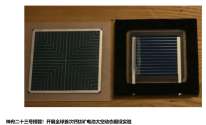
Tianzhou + Shenzhou in-orbit verification: This company's perovskite space photovoltaic full-chain implementation is now in place.​


Stellar Power has achieved a major milestone in China's aerospace energy sector by successfully launching the world's first dynamic space service experiment involving perovskite solar cells aboard the Shenzhou-23 mission to the Chinese Space Station. This groundbreaking initiative, developed through collaboration between Peking University, Beijing Institute of Technology, and Stellar Power, marks the beginning of real-world verification for these next-generation photovoltaic devices under actual orbital conditions. Prior to this manned launch, Stellar Power had already completed two batches of extravehicular exposure tests on Tianzhou-10, where samples operated stably for over 200 days while enduring extreme temperature fluctuations ranging from -170°C to +120°C, proving their resilience against space radiation and harsh environments.
1780097151790.png
Beyond the in-orbit verification phase, Stellar Power is accelerating its transition from laboratory research to commercial industrialization by breaking ground on a pilot-scale production line in Beijing's Future Science City. This 150 million yuan project represents a total investment aimed at establishing a complete supply chain for perovskite space photovoltaics, spanning materials development, device fabrication, and mass production capabilities. To support this rapid scaling, the company secured strategic investment from the park's direct fund upon settling in the industrial park and plans to invest an additional 50 million yuan into R&D during 2026. This financial backing enables the company to launch multiple verification satellites within the year, adopting a core strategy of "space-based verification combined with ground iteration" to refine technology before full-scale deployment.

The technological advantages of Stellar Power's perovskite technology are driving significant innovation in commercial aerospace applications, offering superior performance metrics compared to traditional gallium arsenide batteries. Their independently developed materials boast a photoelectric conversion efficiency exceeding 34% and an impressive power-to-weight ratio of up to 55W/g, reducing satellite weight by over 40% while maintaining flexibility. These characteristics make perovskite solar cells ideal for lightweight requirements in commercial satellites, lunar bases, and deep space exploration missions. By continuously integrating capital empowerment with technological iteration, Stellar Power is reshaping the landscape of global space energy solutions, positioning itself as a core innovative force capable of delivering cost-effective and high-efficiency power sources for China's future aerospace endeavors.

Please, Log in or Register to view URLs content!
 

Blitzo

General
Staff member
Super Moderator
Registered Member
In that case, how many years will it take for China to catch up with the US' current (2026) level of space launch capabilities, then?

Keeping this post here rather than moving it, because the answer is unknowable and depends on how various projects both state and commercial pan out. It's not like we have any good predictions beyond 6-12 months out (even leaving aside the risk/success of certain projects etc)

I'm sure people could model some predictions if they really wanted to and fiddle with various permutations, but not sure what good that would be.
 
Top