
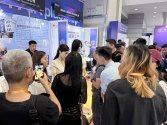
AI integrated female companion robots booth, crowded with people, showed on Shen Zhen robotics forum today.


The total output of Shenzhen’s robotics industry reached a record in 2025, rising 20 per cent from a year earlier to over 242 billion yuan (US$35.4 billion), according to a whitepaper released at Fair Plus – short for Fair of AI and Robotics Plus – which ran from Wednesday to Friday. Shenzhen accounted for 43 per cent of China’s total output of service robots, producing nearly 8 million units last year, while the city manufactured 194,900 industrial robots, accounting for a quarter of the national output, according to the whitepaper. That put Shenzhen at the top nationally for both core robotics categories, the paper added.
The revenue of Shenzhen’s robotics industry cluster jumped 34 per cent to 37.9 billion yuan last year. In terms of technological innovation, the city was home to 4,676 companies holding robotics-related patents in 2025, up nearly 20 per cent from a year earlier, according to the whitepaper.
Chinas is Chinas main tech hub. So not too surprised.
The regional distribution of next generation technologies in China is actually pretty interesting.Chinas is Chinas main tech hub. So not too surprised.

Any companies making agile robotic hands? These are more than useful than running and dancing.

I’m not sure Shenzhen can claim that it leads all of robotics when Unitree is based in Hangzhou.The regional distribution of next generation technologies in China is actually pretty interesting.
Shenzhen leads robotics, with Shanghai in second place. (Little known fact - the Pearl River Delta also leads in sex dolls manufacturing; so the, uh, synergy is not surprising.)
Beijing leads AI, with Byte Dance, Xiaomi, z.AI, and Moonshot. In second place is Hangzhou, with DeepSeek and Alibaba, and Minimax is in Shanghai, so the Yangtze River Delta is a close second. Surprisingly, Shenzhen doesn't feature strongly here.
Biotechnology, EVs, and semiconductors are all more distributed in terms of their industrial chains, with prominent companies across tier 1 and tier 2 cities. Although Shenzen and Shanghai / Hangzhou are probably still the biggest regional centers.
So really, the picture I'm getting is that Shenzhen is really taking the lead in next generation hardware technology, while in AI Beijing is emerging as the center of gravity. The Yangtze River Delta is, however, a close second for both hardware & software, and appears to otherwise specialize in services & entertainment, where it is becoming dominant. Ultimately, the hardware-software synergy between Shenzhen and Beijing will probably be the industrial story of the next decade, while Shanghai / Hangzhou play more in the services space.


There are many other nodes within China's high tech/advanced manufacturing ecosystem. Xian, Chengdu, and Wuhan are all traditional major industrial centers that have successfully made the transition to high-tech, particularly in semiconductors. Hefei has been rapidly emerging as a top research center and semiconductor hub, reaping massive benefits from hosting China's MIT and from targeted smart investment by Anhui's provincial government. Lastly, YRD's dominance in high tech is cemented by the Suzhou-Wuxi megacity, a dominant player in semis packaging, EVs, advanced manufacturing, biotech, materials, chemicals, and electronics.The regional distribution of next generation technologies in China is actually pretty interesting.
Shenzhen leads robotics, with Shanghai in second place. (Little known fact - the Pearl River Delta also leads in sex dolls manufacturing; so the, uh, synergy is not surprising.)
Beijing leads AI, with Byte Dance, Xiaomi, z.AI, and Moonshot. In second place is Hangzhou, with DeepSeek and Alibaba, and Minimax is in Shanghai, so the Yangtze River Delta is a close second. Surprisingly, Shenzhen doesn't feature strongly here.
Biotechnology, EVs, and semiconductors are all more distributed in terms of their industrial chains, with prominent companies across tier 1 and tier 2 cities. Although Shenzen and Shanghai / Hangzhou are probably still the biggest regional centers.
So really, the picture I'm getting is that Shenzhen is really taking the lead in next generation hardware technology, while in AI Beijing is emerging as the center of gravity. The Yangtze River Delta is, however, a close second for both hardware & software, and appears to otherwise specialize in services & entertainment, where it is becoming dominant. Ultimately, the hardware-software synergy between Shenzhen and Beijing will probably be the industrial story of the next decade, while Shanghai / Hangzhou play more in the services space.