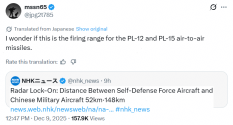
Chinese air to air missiles

Wrought

Captain
Registered Member
No idea where this idea of massive munitions stockpiles comes from. The whole point of converting industrial capacity during wartime is to boost military production. Stockpile raw materials (which is of course happening already), instead of finished products, because raw materials can be used for any product. Keeping modest munitions stockpiles with lots of capacity is far better than the other way around. That's how you end up with huge amounts of waste, fraud, and obsolete gear.
 

Totoro

Major
VIP Professional
Usually one can find claims of AMRAAM having a 10 year shelf life, which can then of course be exteneded by recertifications, rebuilds etc.
There's actually a useful claim by Finnish air marshal who said a small number of their amraams have lifespan into the 2030s. Last of the finnish amraams were delivered in 2020. So it's plausible some regular lifespan, with a possible refit is more like 15 years.

According to 2018 SAR DoD document, which lists both old procurment and planned future procurement to 2024 (which may have changed since 2018) DoN paid for 4461 amraams since 1989. DoAF paid for 12001 amraams since 1987. Certainly a whole lot of that production volume is not in use. Allowing for a 2 year production process from the contract, a 15 year shelf life might yield missiles contracted in 2009 and later. 4459 for DoAF and approx 2900 for DoN. A 20 year shelf life, with multiple refits and recertifications, might yield more missiles in US inventory. But they certainly dont have 16000+ working amraams anymore.
 

Gloire_bb

Major
Registered Member
No idea where this idea of massive munitions stockpiles comes from. The whole point of converting industrial capacity during wartime is to boost military production. Stockpile raw materials (which is of course happening already), instead of finished products, because raw materials can be used for any product. Keeping modest munitions stockpiles with lots of capacity is far better than the other way around. That's how you end up with huge amounts of waste, fraud, and obsolete gear.
It has to be balanced, and it isn't a nice equation. Overall, ability to maintain large stocks and absorb inefficiencies upfront here is a sign of great power.
 

AndrewS

Brigadier
Registered Member
While we don't know, but I would not be surprised if the production of missiles like the PL-15 could reach around the ~1000 a month at max throughput (three 8 hour shifts a day).

While regular output (1 shift likely not even running at 100%) would likely be less than 1/3 of the 1000.

That said, the PL-15 might have stopped, but the new PL-16 or whatever its successor is, can probably do the same.

Or in short, whatever current non wartime production, for China atleast, ramping it up to probably 3x or way more in a short time frame (a month maybe) should not be hard.

Again, PL-15 production of 1000 per month sounds way too high.

After 1 year, that is 12K
After 5 years, that is 60K
After 10 years, that is 120K

1. There aren't enough aircraft capable of using all these PL-15
2. There aren't enough opposing air targets for even 60K PL-15s.

My "guess" would be that PL-15 production has historically been somewhere between 1200-2000 per year.

---

But going forward, we've seen a significant increase in terms of fighter production in the past 2 years, which hasn't yet topped out.

So AAM production (presumably of the PL-16) should be higher.
And if the PL-16 is a smaller form factor, optimised for internal carriage by stealth fighters, you would want stealth fighters to predominantly use the PL-16 instead of the existing stockpiles of PL-15.

Depending on the assumptions, my guess is it will be between 1800-3000 per year

 
Last edited:

Gloire_bb

Major
Registered Member
Depending on the assumptions, my guess is it will be between 1800-3000 per year
at ¬150 tactical aircraft yoy, even 1800 is >10 missiles per aircraft. I.e. 2.5 weapon loads per unit. It's also (let's assume PL-15 is something along the lines of 1 mil USD apiece; it can be scaled back to a degree, but this price is consistent for mass-produced AAMs, significant chunk of the weapon price here is advanced SFRE and seeker, and TRMs don't scale down that much just at this level of production) a lot of money.
This is a rather big investment, esp. since it's only small part of PLAAF/PLANAF weapons budget.
 

AndrewS

Brigadier
Registered Member
at ¬150 tactical aircraft yoy, even 1800 is >10 missiles per aircraft. I.e. 2.5 weapon loads per unit. It's also (let's assume PL-15 is something along the lines of 1 mil USD apiece; it can be scaled back to a degree, but this price is consistent for mass-produced AAMs, significant chunk of the weapon price here is advanced SFRE and seeker, and TRMs don't scale down that much just at this level of production) a lot of money.
This is a rather big investment, esp. since it's only small part of PLAAF/PLANAF weapons budget.

I think tactical aircraft production will be somewhat higher.

1. 160+ of the J-20 and J-35 combined. Based on exceeding total F-35 production per year
2. Plus some Flanker airframes (J-15 and J-16D)

So it's more like 170-200 per year in total

---

The Pakistan order was for 12? AAMs per aircraft.

---

Plus there are already ~300 J-20 in the fleet already.
So it makes sense for some to be equipped with the PL-16, so they can fit [6x PL-16] instead of [4x PL-15]

EDIT

I completely forgot about the Chinese UADFs and American CCAs

That will drive the numbers of PL-16s upwards even more.
 

Wrought

Captain
Registered Member
It has to be balanced, and it isn't a nice equation. Overall, ability to maintain large stocks and absorb inefficiencies upfront here is a sign of great power.

I think your idea of "large" stockpiles is in line with what I described as "modest." Given that some folks here are busy throwing out ridiculous numbers like high tens or even hundreds of thousands.
 

CMP

Captain
Registered Member
Top